The Personal Impact Chain
How product leaders move teams from data to outcomes.


Product leadership is fundamentally about leading without formal authority. You set the direction, align stakeholders, and own outcomes; all without controlling the people who make it happen. That requires something more basic than product intuition: a personal operating system for getting from facts to impact, on any type of project, at any scale.
During my first weeks at McKinsey, a senior partner gave me the most concise career advice. Over dinner, I asked what I needed to get right first.
“Know the data,” he said.
Not “develop executive presence.” Not “build relationships.” Know the data. Everything else, the problem solving discipline, the story, the recommendation, was downstream.
Over the years, I built on it. The Personal Impact Chain is the result: a framework for staying grounded in facts, finding the insights that matter, building the case for change, earning the coalition to act, and delivering outcomes.
This post outlines the Personal Impact Chain framework, and will be followed by an assessment of how AI is likely to shape it.
One chain, every scale
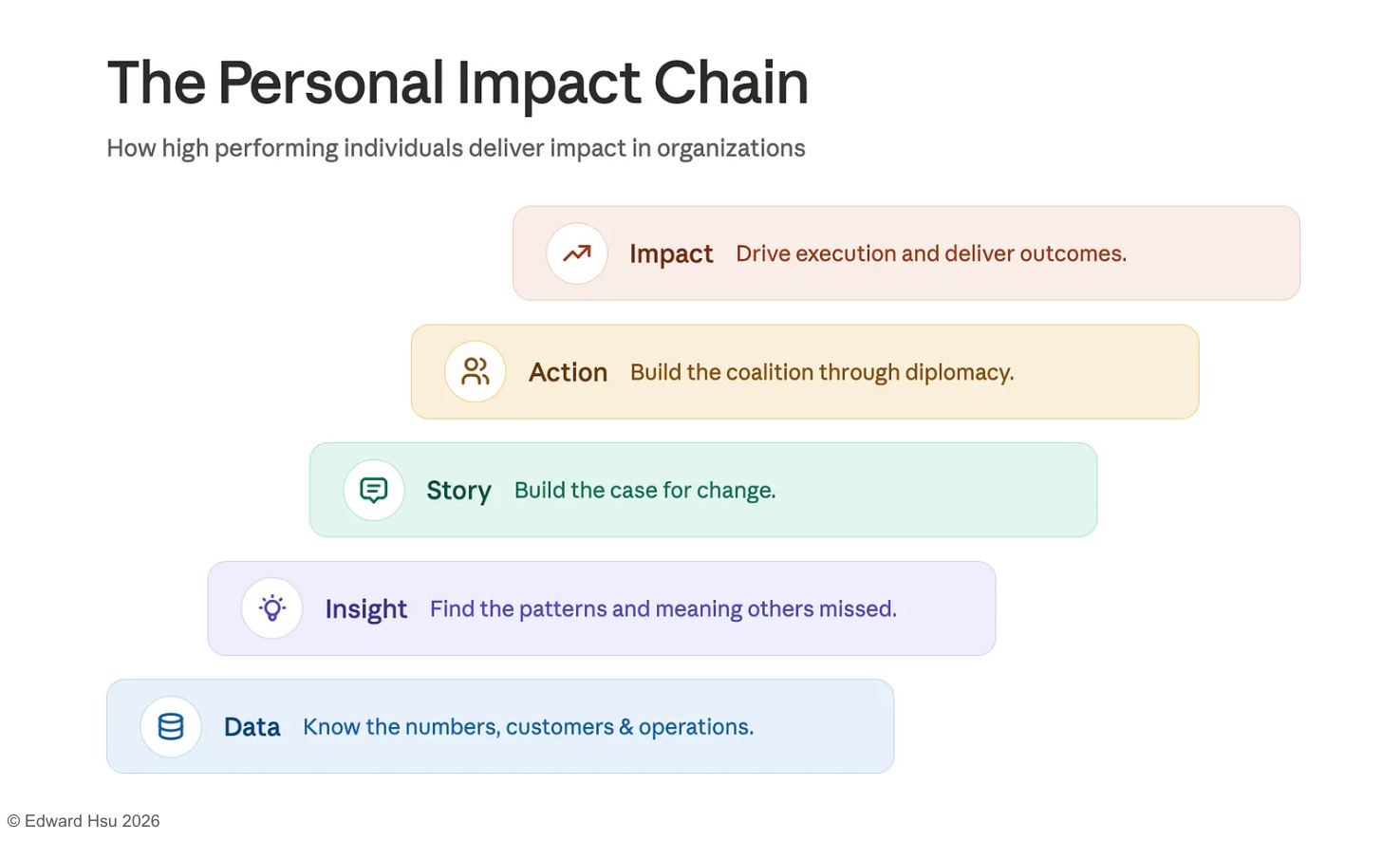
There’s a progression that underlies almost every professional initiative. It’s not in job descriptions, but it structures careers:
Data → Insight → Story → Action → Impact
Like spirals in nature, this progression runs in any scale. From a junior analyst delivering a report to an executive driving a company-wide transformation, it’s the same structural progression, just at a different scope and time horizon.
Action at the small scale is personal discipline. At the large scale it’s about diplomacy, operating models, and a dose of formal authority. At senior levels, this framework maps to how people are evaluated.
Understanding the personal impact chain
This framework has helped members of my team advance, take on bigger roles, and find more satisfaction in their work, long after our time together.

Data
You earn credibility by building the foundation. Knowing the facts is the entry price. You cannot be taken seriously if you don’t know the numbers, the customers, the operating mechanics. It is unglamorous work, and that is precisely why it signals commitment. Bezos made this visceral: being caught without the math behind an assertion was disqualifying in a way that no amount of charisma could repair.

Insight
From facts comes insight, which is often (but not always) quantitative. Stewart Butterfield’s team at Slack discovered that teams exchanging 2,000 messages were 93% likely to stay with the platform. That was when a team had reorganized how they communicated around the tool. They rebuilt onboarding to get teams there faster. Slack launched in 2014 and reached a billion-dollar valuation within a year.
The Slack example illustrates something universal: the most valuable insights are rarely in the data itself. They’re in the question you thought to ask.

Story
Stories make an insight actionable. And storytelling is as old as humans gathering around a fire — it is how we make sense of complexity and move each other to act.

A useful framework for building the case for change is situation, complication, resolution. At VMware in 2013, the situation was that the company was pushing into adjacent markets with multiple business units, each with its own field motion and incentives. The complication was that customers were hearing something different from every team, and no BU had any reason to change. The resolution was to stop organizing around what we sold and start organizing around what customers were trying to achieve.
That case had to land first. And then it had to win.

Action
Inside any large organization, there is never a shortage of good ideas; only a shortage of bandwidth to execute them. Winning isn’t just about being right. It’s about being compelling enough to earn the necessary allocation of people, resources, and leadership attention. This is where the technically excellent often fail.
A famous example is Ignaz Semmelweis, a 19th century Hungarian physician chronicled by Matt Kaplan in his book Told You So: Scientists Who Were Ridiculed for Being Right. Semmelweis figured out what was killing women in childbirth. He had the data, the insight, and the story of what needed to be done. But he couldn’t build the coalition for broader action.
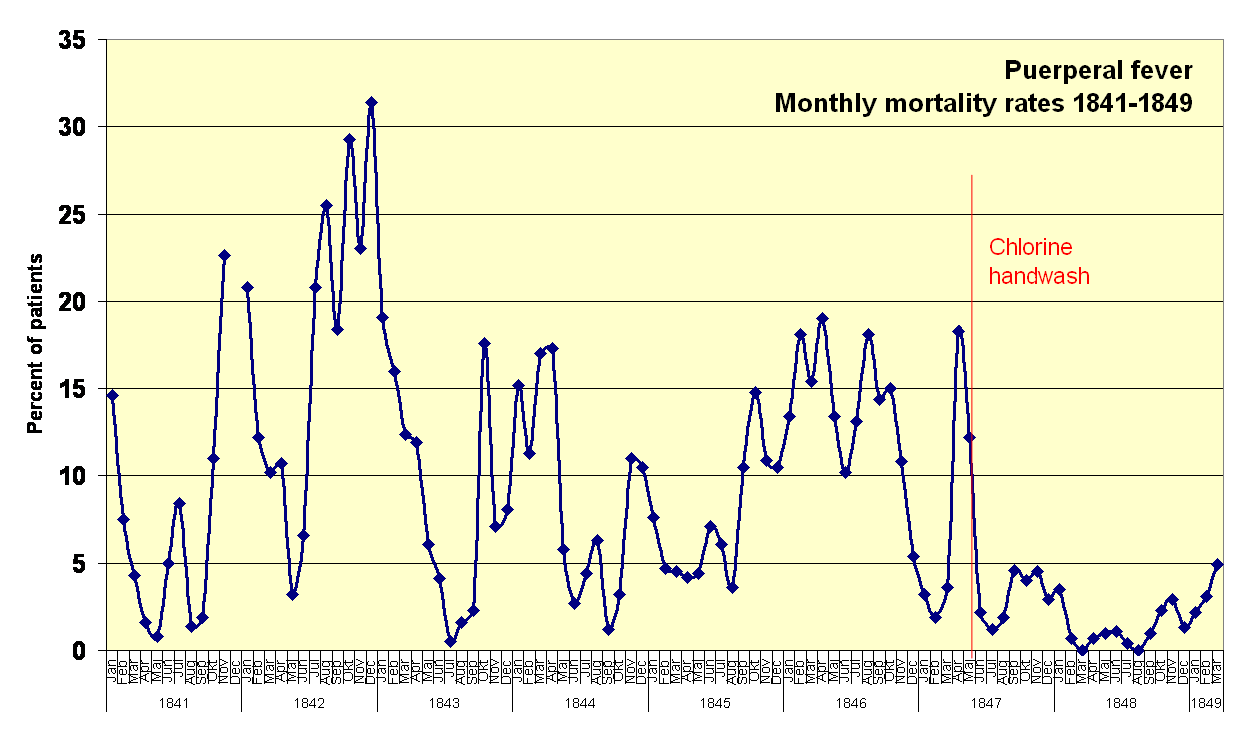
In 1847, working in the maternity ward at Vienna General Hospital, Semmelweis identified that doctors moving directly from autopsies to deliveries were transmitting what he called “cadaverous particles” to their patients. He instituted mandatory handwashing with a chlorinated lime solution, dropping mortality from 18% to 1.27%. In two months of 1848, not a single woman died in childbirth under his care.
Diplomacy would have been critical to drive change, because the facts required the medical establishment to conclude that doctors were killing patients - a very difficult pill to swallow. His position was further complicated by politics: he was an open supporter of Hungarian revolutionaries against the ruling Habsburgs. He was dismissed, and his findings were not adopted in his lifetime.

Impact
If you’re able to get from fact-based insights to an action coalition, with hard work and some luck, comes impact. Everything prior to this step is mission planning. Here, it’s about project management, dependency tracking, risk mitigation, and the willingness to make unglamorous decisions under pressure. The skills that get you to the starting line are not the same ones that carry you across the finish.

The chain determines your ceiling
The chain determines your ceiling more than your floor. Here are two examples: Someone who masters the first two steps but never develops the third can have a long and respected career; technically excellent, right more often than anyone knows, and less influential than their work deserves.
The inverse is someone who leads with story and coalition without a deep engagement with the underlying facts and insight. They can move a room, and once given a mission they can drive it hard. But they are rarely the ones who uncover the mission in the first place, or originate the next one.
In reality, high performing individuals navigate the entire chain, often pulling in colleagues to complement their own strengths and weaknesses to maximize the chances for mission success.
My next essay will cover how AI changes each step, and which ones are worth investing in.
Ed, i remember that this discussion! I'm glad it was helpful!